On a quiet Tuesday evening in March 2024, Sarah Mitchell's life changed in an instant. What began as mild discomfort quickly escalated into a medical emergency that would test the limits of modern healthcare—and ultimately showcase the life-saving impact of community support through the Hillcrest Health Foundation.
Today, Sarah stands as a living testament to the power of comprehensive critical care services, advanced medical technology, and the compassionate healthcare professionals whose work is made possible through philanthropic support. With her permission and encouragement, we share her remarkable journey from crisis to celebration.
The Emergency: When Every Second Counts
"I remember feeling suddenly short of breath while preparing dinner," Sarah recalls, her voice steady but reflective. "Within minutes, the discomfort became overwhelming. My husband called 911, and everything became a blur of sirens, urgent voices, and the realization that something was seriously wrong."
Sarah was experiencing a severe cardiac event—a condition that requires immediate, specialized intervention. The ambulance rushed her to Hillcrest Medical Center, where the emergency department team was already prepared, thanks to advanced communication systems funded by foundation donors. These critical minutes of preparation would prove essential to her survival.
Dr. Michael Chen, the attending emergency physician that evening, explains the significance: "When patients arrive with acute cardiac emergencies, we need immediate access to diagnostic equipment, specialized medications, and a coordinated team response. The foundation's support has enabled us to maintain state-of-the-art emergency capabilities that directly impact survival rates."
Within the first hour, Sarah underwent rapid assessment using advanced cardiac monitoring equipment—technology that had been recently upgraded through a foundation grant specifically designated for emergency cardiac care. The team quickly identified the severity of her condition and initiated the protocols that would save her life.
Critical Care: The Intensive Care Unit Experience
Sarah's condition required immediate transfer to the Intensive Care Unit, where she would spend the next twelve days under constant monitoring and specialized treatment. The ICU at Hillcrest Medical Center represents one of the most significant beneficiaries of foundation support, with recent investments in advanced monitoring systems, specialized equipment, and staff training programs.
"The first few days are honestly a fog in my memory," Sarah shares. "But my family tells me about the incredible care I received—nurses who checked on me constantly, doctors who explained everything to my worried husband, and technology that seemed to anticipate problems before they became critical."
Jennifer Rodriguez, the ICU nurse who coordinated much of Sarah's care, describes the comprehensive approach: "We utilize integrated monitoring systems that track dozens of vital parameters simultaneously. When Sarah's condition showed early signs of complications, the system alerted us immediately, allowing intervention before the situation became critical. This technology, funded through foundation grants, has transformed our ability to provide proactive rather than reactive care."
The ICU team employed several advanced interventions during Sarah's stay, including specialized cardiac support equipment, continuous renal replacement therapy, and advanced respiratory management—all services enhanced or made possible through foundation-supported programs. Each piece of equipment, each specialized medication, and each trained staff member represented an investment in saving lives like Sarah's.
"What struck me most during those critical days was the seamless coordination," recalls Sarah's husband, David. "Every person who entered that room—doctors, nurses, respiratory therapists, pharmacists—they all seemed to be working from the same playbook, focused entirely on Sarah's recovery. Later, we learned that the foundation had funded interdisciplinary training programs that created this level of teamwork."
The Turning Point: Progress and Hope
On day seven, Sarah experienced what her medical team describes as a significant turning point. Her vital signs stabilized, her cardiac function showed marked improvement, and for the first time since admission, she was able to communicate clearly with her family and caregivers.
"I remember waking up more alert and seeing my daughter's face," Sarah says, emotion evident in her voice. "She was holding my hand, and I could actually squeeze back. That moment—that simple gesture—felt like winning the lottery. I knew I was going to make it."
This turning point was no accident. It resulted from the cumulative effect of excellent medical care, advanced technology, and comprehensive support services. The cardiac rehabilitation specialist visited Sarah's bedside to begin early mobility exercises—a program established through foundation funding that has been shown to significantly improve recovery outcomes for critical care patients.
Dr. Patricia Williams, the cardiologist overseeing Sarah's recovery, emphasizes the importance of this comprehensive approach: "Critical care isn't just about keeping patients alive through the acute crisis—it's about optimizing their recovery trajectory from day one. The foundation's support allows us to provide services like early rehabilitation, nutritional counseling, and psychological support that dramatically improve long-term outcomes."
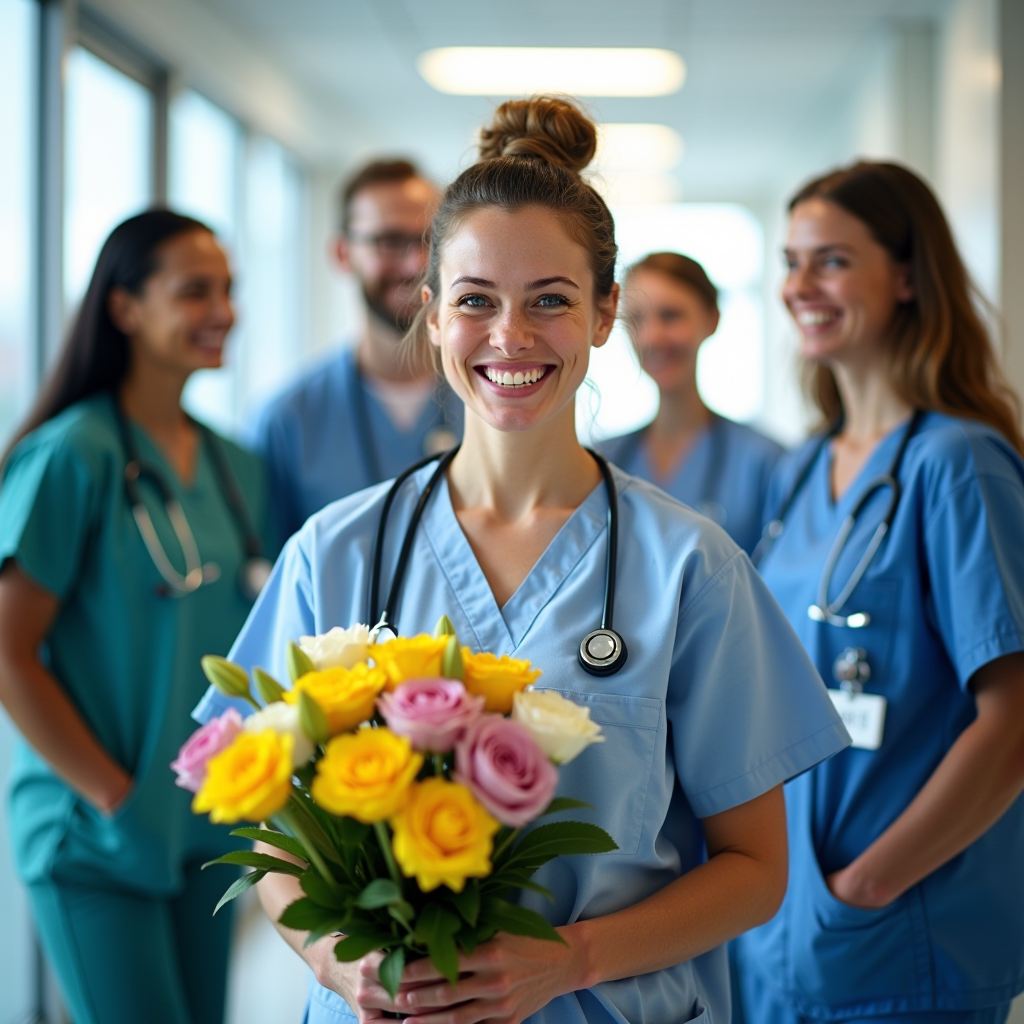
Sarah Mitchell celebrating her recovery with the medical team who saved her life (photo shared with patient permission)
Recovery and Rehabilitation: The Road Home
After twelve days in intensive care, Sarah transitioned to the cardiac step-down unit, where she continued her recovery under close supervision but with increasing independence. This phase of care, often overlooked in discussions of critical care, proved essential to her successful return home.
"The step-down unit felt like a bridge between the intensive care I needed and the normal life I was working to reclaim," Sarah explains. "The nurses taught me how to recognize warning signs, how to manage my medications, and how to gradually rebuild my strength. They treated me not just as a patient, but as a person preparing to go home."
The cardiac rehabilitation program, enhanced through foundation grants, provided Sarah with structured exercise sessions, nutritional counseling, and education about heart health. Physical therapists worked with her daily, gradually increasing her activity level while monitoring her cardiac response. Occupational therapists helped her prepare for daily activities at home, ensuring she could safely manage tasks like climbing stairs and carrying groceries.
"What many people don't realize is that recovery from a critical illness extends far beyond the hospital walls," notes Rebecca Thompson, the cardiac rehabilitation coordinator. "Our program, supported by foundation funding, provides six months of supervised rehabilitation, ongoing education, and support groups. This comprehensive approach reduces readmission rates and helps patients like Sarah not just survive, but truly thrive."
Sarah participated in weekly support groups where she connected with other cardiac patients, sharing experiences and encouragement. These groups, facilitated by social workers whose positions are partially funded through foundation grants, provide emotional support that complements the physical rehabilitation process.
The Foundation's Impact: Beyond Medical Equipment
As Sarah learned more about her care, she discovered the extensive role that foundation support played in her survival and recovery. The advanced cardiac monitoring equipment, the specialized ICU beds that prevented pressure injuries, the rehabilitation equipment, the support group programs—all represented investments made possible by community donors.
"I had no idea how much of my care was enhanced by foundation support," Sarah reflects. "I assumed everything was just standard hospital equipment and services. Learning about the foundation's role made me realize that my survival was a community effort—not just the medical team, but everyone who had donated to make that level of care possible."
The foundation's impact extended beyond equipment to include staff education and training. Many of the nurses and therapists who cared for Sarah had attended specialized training programs funded by foundation grants. These programs ensure that Hillcrest Medical Center's staff remain current with the latest evidence-based practices in critical care.
Dr. Chen emphasizes this often-overlooked aspect of foundation support: "Advanced equipment is crucial, but it's only as effective as the people using it. Foundation funding for continuing education, specialized certifications, and training programs ensures our team can provide truly exceptional care. Sarah benefited from both cutting-edge technology and highly trained professionals—a combination made possible by philanthropic support."
Life After Crisis: Sarah's New Normal
Today, ten months after her emergency admission, Sarah has returned to a full, active life. She works part-time as a teacher, volunteers at her local community center, and has become an advocate for heart health awareness. Her recovery, while requiring ongoing management and lifestyle modifications, represents a complete success story.
"I'm not the same person I was before this happened," Sarah acknowledges. "I'm more aware of my health, more grateful for each day, and more committed to giving back to the community that saved my life. I've started volunteering with the foundation, sharing my story to help others understand the importance of supporting healthcare."
Sarah's cardiologist confirms her excellent progress: "Sarah represents the best possible outcome from a critical cardiac event. Her recovery has been remarkable, and she's maintained the lifestyle changes necessary for long-term health. Cases like hers remind us why we do this work and why community support through the foundation is so vital."
The ripple effects of Sarah's recovery extend throughout her community. She speaks at foundation events, participates in heart health awareness campaigns, and mentors other cardiac patients through their recovery journeys. Her experience has transformed her from a patient into an advocate, amplifying the foundation's mission through her personal testimony.
The Human Side of Healthcare Philanthropy
Sarah's story illuminates the profound human impact of healthcare philanthropy. Behind every piece of medical equipment, every training program, and every enhanced service stands a person whose life may depend on that investment. Foundation donors often contribute without knowing whose life they might save—but Sarah's story provides a face and a voice to that abstract concept.
"When people donate to the foundation, they might think about equipment or buildings," Sarah observes. "But what they're really doing is giving people like me a second chance at life. They're giving my husband his wife back, my daughter her mother, my students their teacher. That's the real impact—not just medical outcomes, but preserved families and continued relationships."
Foundation director Margaret Sullivan reflects on stories like Sarah's: "We measure our impact in many ways—dollars raised, equipment purchased, programs funded. But the true measure is in stories like Sarah's. Every donor who contributes to critical care services is directly participating in saving lives. Sarah's recovery represents the collective generosity of hundreds of community members who chose to invest in healthcare excellence."
The comprehensive nature of Sarah's care—from emergency response through intensive care to rehabilitation and ongoing support—demonstrates how foundation funding creates an integrated system of excellence. No single donation or grant made the difference; rather, years of sustained community support built the infrastructure, trained the staff, and provided the resources that saved Sarah's life.
Looking Forward: Continuing the Mission
Sarah's successful recovery story, while inspiring, represents just one of many lives touched by foundation-supported critical care services. Each year, hundreds of patients benefit from the advanced equipment, trained staff, and comprehensive programs made possible through philanthropic support.
The foundation continues to invest in critical care excellence, with current initiatives including expansion of the ICU monitoring systems, enhancement of cardiac rehabilitation programs, and development of new patient education resources. Each initiative builds on the foundation of community support that made Sarah's recovery possible.
"My hope is that by sharing my story, others will understand the vital importance of supporting healthcare," Sarah says. "Every donation, regardless of size, contributes to saving lives. I'm living proof of that. The foundation didn't just help me survive—they helped me thrive, and I'm committed to ensuring others have the same opportunity."
As Sarah continues her recovery journey and her advocacy work, she embodies the foundation's mission: transforming community generosity into life-saving healthcare. Her story serves as a powerful reminder that healthcare philanthropy isn't about abstract concepts or institutional goals—it's about people, families, and the precious gift of life itself.
Sarah's journey from crisis to celebration demonstrates the transformative power of comprehensive critical care services supported by community philanthropy. Her story is not unique—it represents the daily miracles made possible when advanced medical expertise meets generous community support through the Hillcrest Health Foundation.
As we celebrate Sarah's recovery, we also celebrate the donors, volunteers, and supporters who make such outcomes possible. Every contribution to critical care services represents an investment in saving lives, supporting families, and strengthening our community's healthcare infrastructure. Sarah's story reminds us that behind every statistic, every piece of equipment, and every program stands a person whose life has been forever changed by the generosity of others.